Wednesday, February 23, 2022

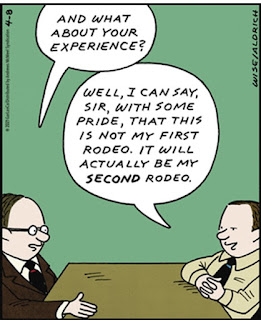
My first rodeo.


I don’t remember my first rodeo. Or my second rodeo. While I have memories of many, many rodeos over many, many years those memories are somewhat muddled and there are no numbers assigned.

Most likely, my first rodeo was a hometown Pioneer Day affair during which little kids like me were screwed down onto the backs of Hereford or black bally calves, with two hands in a death grip on a loose rope, then turned out into the arena for a few (very few) frantic seconds of jolting and jarring and jerking before landing in the dirt with a better than even chance of getting a mouthful of the stuff.

The first rodeo I have record of was a Little Buckaroo Rodeo in Orem, Utah, on Friday, May 31, 1963. On the printed program, right after “Specialty Act—Trampoline” came Section III of Pony Bareback Riding, and there I am, in black and white, with my age listed as 10. Next to my name, in my dad’s handwriting, is my score: “0.” I learned nothing from the experience. For several more years I kept getting on bareback horses that didn’t want me on them—through high school, amateur, college, and pro rodeos.

 When circumstances require, I can honestly say (for what it’s worth), “This ain’t my first rodeo.”

I am now of an age that my last rodeo, like my first, is so long ago that any memory of it has leaked out of my porous brain. There may be a connection.

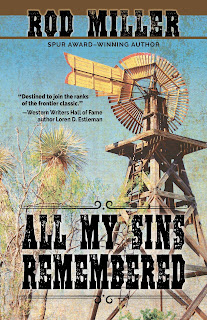
P.S. My latest novel, All My Sins Remembered, is now available in hardcover from Amazon and other online booksellers. Your local bookstore can order it, and it should be in libraries soon.

Saturday, February 12, 2022

At the movies.


One of my favorite movies, and certainly one of my favorite Westerns, is Butch Cassidy and the Sundance Kid.

I am fully aware that it bends and twists history until reality is unidentifiable, and faithfulness to actual events is lacking. Still, it does have some basis in fact. And, let’s face it, it’s not as if even the most studied scholars and historians agree about the exploits and adventures, the villainy and vices, the lives and deaths of Robert LeRoy Parker and Harry Alonzo Longabaugh.

What do I like about the movie? For one thing, it’s funny, and humor is one thing that’s sadly lacking in Old West film and fiction. The picture above portrays the climax of one of the movie’s most hilarious moments, Butch and Sundance’s escape from a persistent posse by leaping from a cliff to a river below following a furiously funny debate. Then there’s the fact that the actors, Paul Newman and Robert Redford, are masters of the craft and their partnership here, as well as in The Sting, is inspired given the on-screen chemistry between them. And it’s well written and well-directed. Finally, much of the movie was shot in and around my home state of Utah, showcasing the wild beauty of our varied landscape.

I don’t know how many times I’ve watched Butch Cassidy and the Sundance Kid. I last loaded up the DVD a few months ago. And it won’t be too many months before I see it again.


Tuesday, February 1, 2022

Old poem.

You can’t live without ageing. One day it dawns on you that you are no longer young. Then, someday, it occurs to you that you are old.

We all know it’s coming. Still, we are often surprised and sometimes shocked at the realization. Despite the passing years and the accompanying changes we can’t ignore, there are many, many other things inside us unchanged since our salad days. And that, I believe, is behind the bewilderment of finding yourself old.

The bewilderment of finding yourself old is the inspiration behind “Through a Glass Darkly,” a new poem built around a bunkhouse cowboy’s wonderment at what has become of him.

And what comes next for all of us. Live well.

Through a Glass Darkly

Chipped and cracked, fogged
by seasons and dimmed by years,
the face in the glass confounds;
furrows deepen, wrinkles ridge.

He turns away, hand wavering
unassured, touches tousled
sougan and sits, head in hands,
eyes shut but unsettled.

Stands again to stare into the glass
at creases and canyons and crags
and coulees cut by wind
and sun and snow and smoke.

He reads the lines that tell
of blisters and burning hair
and the bloody blades
of a hundred branding fires.

Wan forehead marked by hard line
over tangled brow bristles shading
whiskers whitened on wizened
chin and cheeks burnt brown.

How the hell has it come to this?
he will wonder, till one day he looks
in the mirror and there’s no one there
to look back.


Thursday, January 20, 2022

A different book.

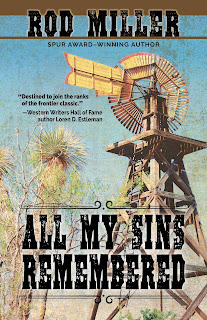
In my previous post I mentioned that All My Sins Remembered, my latest novel from Five Star, is different from any other novel I have written. Different, as well, from any novel I have ever read. You may wonder what makes it different. Well, maybe not. But I wondered, so I gave it some thought. Here are seven things that make it unusual:

1. Almost the entire story takes place in one location.

2. Two of the most important characters are a dry well and a windmill.

3. Only three people continue from beginning to end, and one of them never speaks.

4. The story is narrated by the main character, who is completely repugnant.

5. We never know the name of any character in the book.

6. The story is suspenseful to the point of causing anxiety.

7. Brief scenes of sudden, graphic violence are at the core of the story.

Several months elapsed between completing All My Sins Remembered and proofreading the galleys prior to publication. I was as surprised as you will be with the story—that is to say, much of the language and many of the details surprised me. That, too, is unusual. It was almost as if someone else had written the book and I was reading it for the first time. Go figure. Go read.


Tuesday, January 11, 2022

Coming soon.


Sometime in February, Five Star will release my latest novel, All My Sins Remembered. It is unlike any other novel I have written, and I am not even sure where it came from. But those who have read it seem to like it—if “like” is the right word for such a dark, suspenseful tale.

Loren D. Estleman is a member of the Western Writers Hall of Fame, winner of numerous Western Writers of America Spur Awards and Wrangler Awards from the National Cowboy and Western Heritage Museum, and a best-selling author of both Western and private-eye novels. He says, “All My Sins Remembered is destined to join the ranks of the frontier classic. Here is suspense as taut as freshly strung barbed wire, rock-solid period detail, and an emotional roller-coaster ride set against a West that is both historically accurate and stunningly immediate. Rod Miller does what only a handful of writers have ever done: make you care about (and even perhaps root for) an astonishingly evil man.”

Another winner of the Wrangler Award and a Spur Award winner, Western novelist Michael Zimmer says, “One of the more powerfully haunting novels to come along in years, Miller’s All My Sins Remembered stands shoulder to shoulder with such literary classics as Cormac McCarthy’s Blood Meridian and Charles Frazier’s Cold Mountain. A brutal, beautifully rendered masterpiece, guaranteed to stay with you long after the last page is turned.”

Finally, Marc Cameron, New York Times Bestselling author of several Tom Clancy novels as well as the Jericho Quinn and Arlis Cutter political and law enforcement thrillers, says, “All My Sins Remembered is hypnotic and poetic and vivid.”

Watch for All My Sins Remembered. As I said, it is unlike anything I have written before. And, I suspect, unlike anything you have read before.


Monday, January 3, 2022

A healthy obsession.

For several years now, I have been obsessed with the Massacre at Bear River. I can’t say for sure when this obsession took hold, but I do remember why.

The history of the American West has always been of interest to me, and that interest has always included our growing nation’s history of eliminating any competition for the land and its resources. In other words, the systematic exclusion and eradication of the native tribes that occupied the land.

At some point in my education, after years of study, I learned about the Massacre at Bear River where, on 29 January 1863, the United States Army launched a dawn attack on a Shoshoni village and killed some 250 to 350 men, women, children, and babies. Most of the dead were noncombatants. And the annihilation included rape and torture, as well as the destruction of food, clothing, lodges, and the theft of the horse herds on which the people relied. It was the deadliest massacre of American Indians by the Army in all of Western history.

I was astounded—dumbfounded—that such a pivotal event had largely escaped notice in American history. Little had been written about it, and most of what had been published was incomplete at best, and inaccurate at worst.

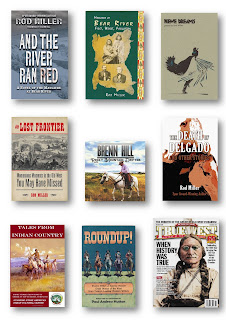
Thus began my obsession. The result, to date, is represented above. I have written a lot about the Massacre at Bear River. Most recently, a novel. Before that, in no particular order, a nonfiction book and shorter pieces of nonfiction included in a book and for a magazine. Short fiction for an anthology, and published in my own collection of short stories. Poems in an anthology and a chapbook. And a poem that became a song.

There may well be more to come, as the Massacre at Bear River continues to haunt me.

When January 29 rolls around again, as it will in a few weeks, I hope to be at the site of the Massacre at Bear River to once again join the Northwestern Band of the Shoshone Nation in honoring their departed ancestors, who have yet to claim their proper place in history.


Monday, December 20, 2021

True confession.

At the risk of sullying whatever credentials I carry in the cowboy and Western cultures, I have a confession to make.

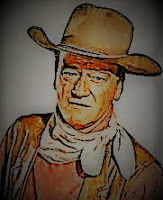
I am not a big fan of John Wayne.

Once you have caught your breath, please read on.

While there is no doubt that The Duke made many stellar performances, and remains a movie star without parallel, it is my opinion that he played but one character in all his movies: John Wayne. It always seems to me that when watching him, I am watching John Wayne playing a cowboy. Or John Wayne playing a gunfighter. John Wayne playing a lawman. And so on.

On the other hand, when I watch what I consider better actors, I see a cowboy played by Robert Duvall. A gunfighter played by Clint Eastwood. A lawman played by Jeff Bridges. And so on, to include Tommy Lee Jones, Robert Redford, Richard Farnsworth, Gene Hackman, Tom Selleck, Paul Newman, Ed Harris…. You get the idea. I like actors who become the character they portray, rather than the character becoming the actor. To me, it is not a subtle distinction.

I once penned a profile of John Wayne as part of a collection of influential Westerners I wrote for American Cowboy magazine. I guess it was suitably reverential as it drew a fan letter—a brief email, actually—from one of John Wayne’s sons, praising the piece and saying it was one of the finest tributes he had ever read about his father.

I meant every word of it. Still…