Saturday, July 25, 2015

Lies They Tell Writers, Part 17: Follow the Formula


“Genre” publishing is what they often call it. The business side of the business has created all these boxes to fit books into, whether responding to reader expectations or creating them.
There’s my favorite box—Westerns. And there are mysteries, science fiction, fantasies, romances, thrillers, “chick lit,” and on and on. And each classification often includes sub-genres, such as Action Westerns, Historical Westerns, Western Romances, Western Mysteries, and Adult Westerns, for instance.
All this categorization is fine. Many readers want to know what they’re in for. The problem is, giving readers what they expect often gets carried to extremes, resulting in formulaic sameness and stagnation. Sometimes it gets downright mechanical and methodical—someone has to get kissed by page such and such, there must be a gunfight every thus-and-so many pages, there must be at least two-point-five incidents of some-such every so often, and that sort of thing. I have even heard of authors and editors creating graphs to chart expected events and adjusting the story to fit.
All well and good.
Except one would be hard pressed to find a widely recognized and highly acclaimed novel that adheres to any formula.
Lonesome Dove doesn’t conform to anyone’s expectations. Blood Meridian breaks all the rules when it comes to Western novels. Elmer Kelton traveled his own trail more often than not. I once heard him say that rather than being “six-foot-two and bullet proof” as expected in a heroic Western character, his were more likely to be “five-foot-seven and nervous.”
There are, of course, many other examples of successful novels in every genre that do not follow the formula.
So, when you have a story to tell, don’t turn it into ingredients for someone else’s recipe—tell it the way it wants to be told. 

Friday, July 17, 2015

Back in the Saddle.


In the June-July issue of Ranch & Reata magazine ( www.RanchandReata.com ), you’ll find a feature article I wrote about Amberley Snyder. But all my words on all those pages do not capture her spirit and attitude, I think, as well as the closing lines of Charles Badger Clark’s poem “The Westerner”:

For the sun wheels swift from morn to morn
And the world began when I was born
      And the world is mine to win.

Amberley has been horseback from an early age, and winning buckles and saddles and trophies in the rodeo arena for nearly as long. A truck wreck—and the resulting paralysis—that would have sidelined most of us barely slowed Amberley down. She, and her horses, learned to ride again and she is back to her winning ways.
There’s just no holding this young woman back, and her enthusiasm for making the most of every new day is an inspiration.

( The photo of Amberley and her barrel horse Power is by Lauren Anderson: www.facebook.com/Landersonphoto )


Friday, July 10, 2015

Me and my big mouth.


There’s no mistaking the fact that the American West faces a conundrum of quandaries, complications, obstacles, problems, predicaments, pickles, trials, troubles, hurdles, hitches, challenges, difficulties, and other such stuff.
Times might be tougher than ever before in history.
On the other hand, it could be that we hear more bad news more often because of the omnipresent communications technology we’re saddled with these days.
Whatever the case, the West—and the world—would be a better place if we would stop shouting at one another and sit down and simply talk.
That, more or less, is the premise of an opinion piece I wrote for the current issue of American Cowboy magazine. Lines from the poem “The Second Coming” by William Butler Yeats inspired the essay. “The centre cannot hold,” he wrote. And I argue it is because of these later lines from the poem: “The best lack all conviction, while the worst are full of passionate intensity.”
The August-September American Cowboy is on newsstands now and, of course, available by subscription. ( www.americancowboy.com ) If my opinion doesn’t suit you, you’ll likely find plenty else in the magazine’s pages that will.


Saturday, July 4, 2015

Lies They Tell Writers, Part 16: Just Say It.

Some time ago, I said in one of these screeds that in good writing “what” you say is important, but “how” you say it is every bit as—if not more—important.
That prompted a comment from a friend, fellow writer, and former teacher that, to his way of thinking, the two are inseparable. I guess we are of different minds. Here’s an explanation. In some of the workshops I teach I use this example to demonstrate:

“In 1776, our founding fathers, desiring freedom and equality for all, created the American nation.”

That sentence is a fairly good, if simplistic, explanation of the birth of our country. It says what it needs to say and does so in a straightforward manner without a lot of foofaraw.
But, the same thought, the same idea, the same “what,” in the hands of a better writer comes out this way:

“Four score and seven years ago our fathers brought forth on this continent, a new nation, conceived in Liberty, and dedicated to the proposition that all men are created equal.”

That writer was, of course, Abraham Lincoln, opening the lid on his immortal Gettysburg Address. And while my line captured the “what” of it equally well, it will never be immortal.
All because Mr. Lincoln didn’t just say it—he paid more attention to the “how” of saying it.
(If you look hard enough, you’ll see Honest Abe circled in the 1863 photo, below, from the Gettysburg dedication ceremony.)


Monday, June 29, 2015

Happiness is Lubbock, Texas…


To paraphrase an old Mac Davis song, happiness is Lubbock, Texas, in my rearview mirror.
We’re just back from a visit there for the annual Western Writers of America convention. Leaving Lubbock was a happy occasion because when we left town I took with me a WWA Spur Award for my novel Rawhide Robinson Rides the Range and a Spur Finalist Award for my poem “Song of the Stampede” from my book Goodnight Goes Riding and Other Poems. 
Beyond that, it was enjoyable just being there.
There’s a lot of music in the air in Lubbock—besides Mac Davis, rock and roll pioneer Buddy Holly called the place home. Multi-talented Andy Wilkinson is from Lubbock, and he writes some of the best-ever songs and poems and plays about the American West and its people. He entertained WWA members with the able assistance of his Lubbock neighbor and saddle pal, singer-songwriter Andy Hedges.
Finally, it’s always enjoyable to attend the WWA convention to renew old friendships and make new ones. There is little in life as agreeable as hanging around with folks who love the West and words and writing and appreciate the difficulty of getting an idea down just right—say, for instance, capturing a young man’s quest for adventure with a line like, “I thought happiness was Lubbock, Texas, in my rearview mirror.”


Saturday, June 20, 2015

Riding the Range with Rawhide Robinson.


Soon we’ll be setting out for the Llano Estacado and an adventure with Rawhide Robinson. As announced earlier, the novel in which he stars, Rawhide Robinson Rides the Range, is the winner of this year’s Spur Award for Best Western Juvenile Novel from Western Writers of America.
We’ll leave the Wasatch Front, cross paths with the trail Dominguez and Escalante blazed as well as the Old Spanish Trail, head east through the Colorado Rockies past Doc Holliday’s grave, travel south beyond Pikes Peak to connect with the Santa Fe Trail over Raton Pass, then southeast to the XIT Ranch and Dalhart, Texas, on to Amarillo and the Frying Pan Ranch, south past Charlie Goodnight’s Palo Duro Canyon, then on to Lubbock and the annual WWA convention.
It’s a Wild West journey Rawhide Robinson himself would be proud of. But I doubt we’ll experience the kind of extraordinary adventures he did. You are invited—encouraged, even—to ride along with Rawhide Robinson as you read about his escapades in the award-winning novel, suitable for grown-ups and young adults alike. You can get it through online booksellers and it’s available through your local bookstore.

Saturday, June 13, 2015

Point and shoot.

I am not a photographer. But, in the course of magazine writing I am often expected to provide pictures to illustrate stories. So, most of what I shoot is journalistic or documentary-type stuff.
But when something interesting in an artistic sense presents itself, I point and shoot and try to capture it. I look for odd angles and unusual arrangements, strange combinations and patterns of colors—things that look almost abstract or graphic in nature. None of the photos here are posed; all were taken on the fly. Only a couple of the images are cropped; the rest are full-frame just as the camera caught them.
Take a look if you’ve got the time. But remember—I am not a photographer.

At the rodeo.
The behind-the-scenes rodeo photos were taken at a high school and a college rodeo. Then there are a couple of shots representing success. Finally, a pair of detail pictures of Jeff Wolf’s monumental sculpture “Rodeo” that I think capture the art’s dynamic action.


At the ranch.
A skyline shot of gathering cattle off Midnight Creek starts this selection, followed by several pictures from a branding. The set ends where it started, with an Idaho ranch horse with a mecate and hackamore hanging from the saddle horn.


At work.
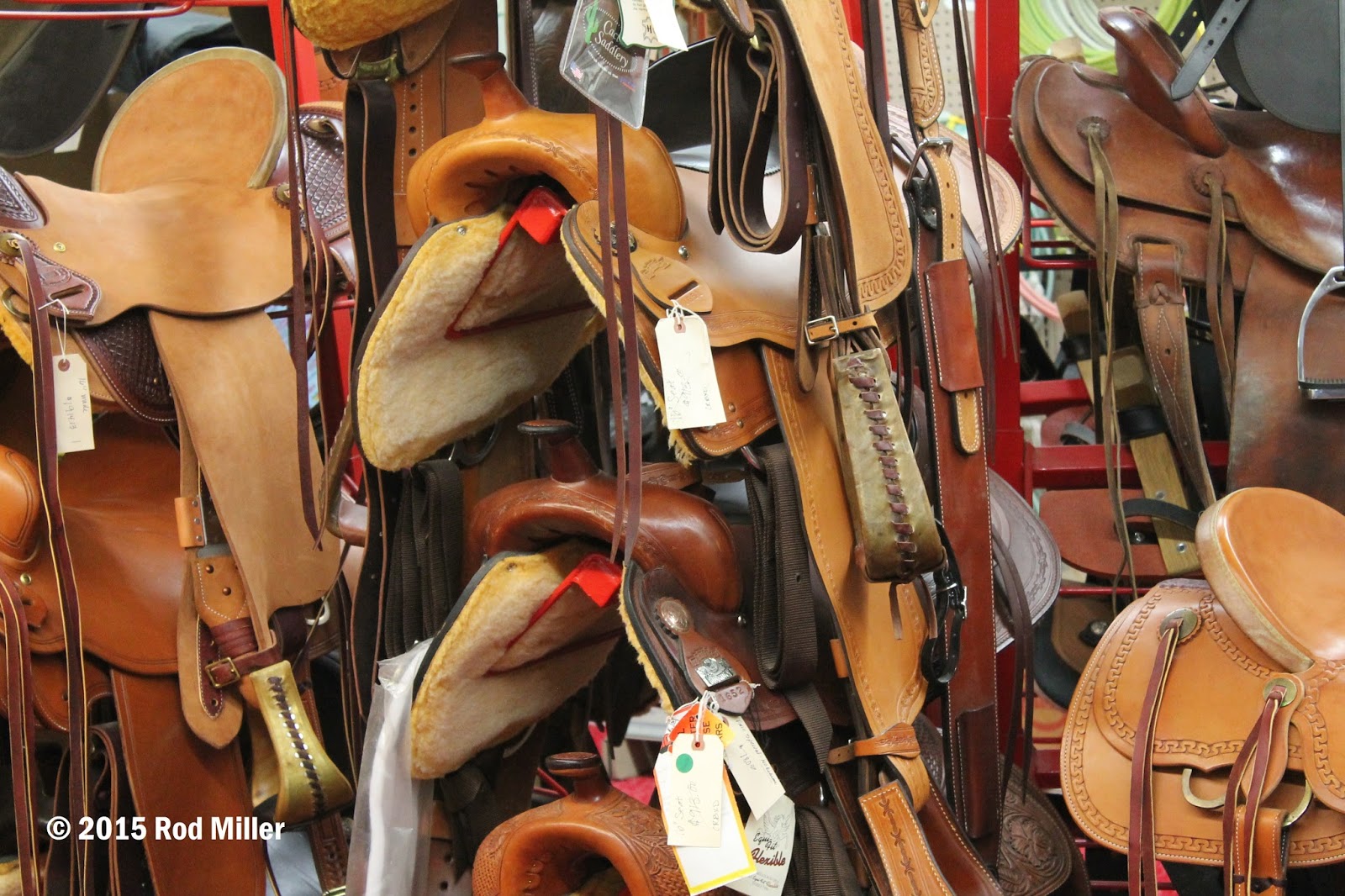
Working with leather is a job, a craft, a skill, and an art. While doing stories on a couple of those artists I captured a few behind-the-scenes photos of some of the tools and materials the artists employ, ending with saddles for sale and an extreme close-up of a maker’s mark stamped into leather.


At play.
Guitars can look as good as they sound. This lone photo comes from the practice pen of Mary Kaye and the Kaye Sisters as they blended bended strings and harmonized sweet voices.